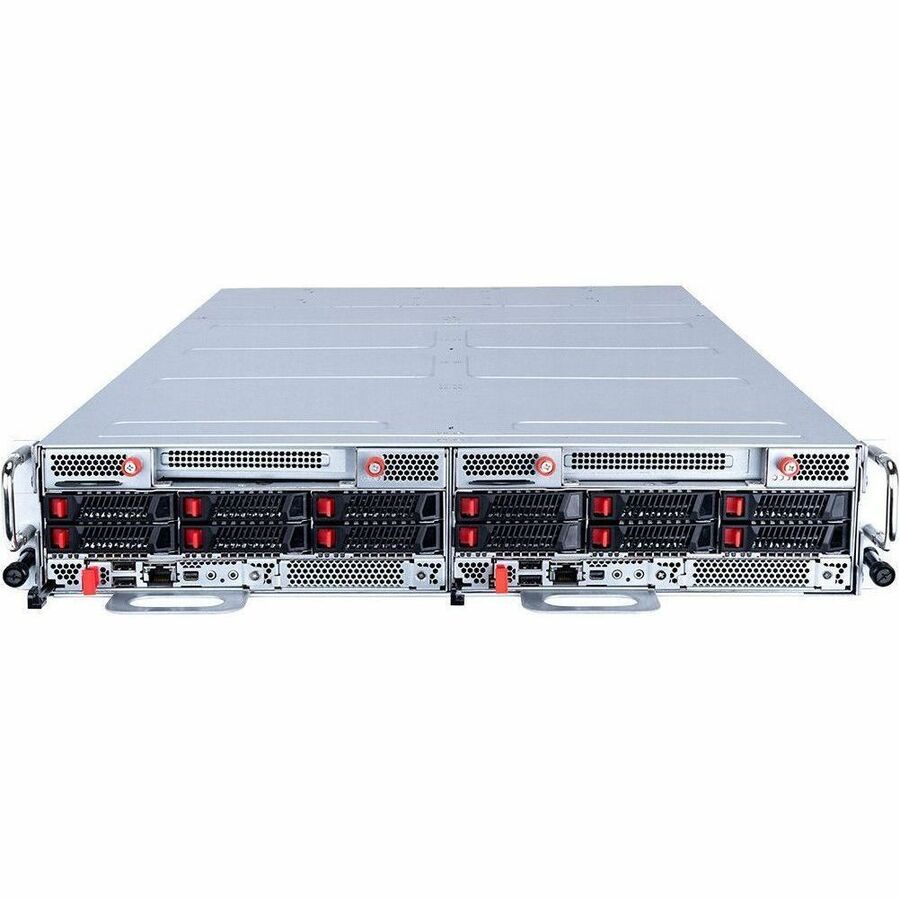
| Product Type: Barebone System |
| Manufacturer Website Address: http://www.msi.com |
| Maximum Memory Supported: 256 GB |
| Form Factor: Rack-mountable |
| Manufacturer: MSI |
| Product Model: CD270-S4051-X2 |
| Product Name: CD270-S4051-X2 Barebone Systems |
| Processor Supported: EPYC |
| Controller Type: NVMe |
| Rack Height: 2U |
| Brand Name: MSI |
| Memory Technology: DDR5 SDRAM |
| 64 Bit Processing: Yes |
| Thermal Design Power: 500 W |
| Processor Manufacturer: AMD |
| Chipset Manufacturer: AMD |
| Graphics Controller Manufacturer: ASPEED |
| Number Of Power Supplies Installed: 2 |
| Graphics Memory Accessibility: Dedicated |
| Number Of Processors Supported: 1 |
| Ethernet Technology: Gigabit Ethernet |
| Number Of Total Expansion Bays: 6 |
| Number Of Pci Express X16 Slots: 2 |
| Number Of Network (Rj 45) Ports: 1 |
| Network (Rj 45): Yes |
| Maximum Power Supply Wattage: 2400 W |
| Total Number Of Usb Ports: 2 |
| Number Of 2.5" Bays: 6 |
| Total Number Of Expansion Slots: 2 |
| Mini Displayport: Yes |
| Number Of M.2 Interfaces: 2 |
| Total Number Of Memory Slots: 12 |
| Energy Efficiency Compliance: Energy-related Products Directive (ErP) |
| Environmental Compliance: Restriction of Hazardous Substances (RoHS),Waste Electrical and Electronic Equipment Directive (WEEE) |
| Feature1: Upgrade an existing PC easily to improve performance and extend its usability for modern applications |
| Feature2: Perform computational tasks efficiently with EPYC processor for smooth and reliable performance |
| Feature3: With NVMe interface, experience high-speed data transfer and robust reliability for optimized system performance |
| Feature4: Rack-mountable barebone system ensures clutter-free, organized setups with improved accessibility and efficiency |
| Feature5: Can connect up to 2 USB peripherals for versatile and productive device integration |
| Feature6: Gigabit Ethernet is highly efficient for large file transfers, making it ideal for backups and heavy data workflows |
| Feature7: The DDR5 SDRAM memory technology moves data efficiently across components, ensuring smooth and responsive PC performance |