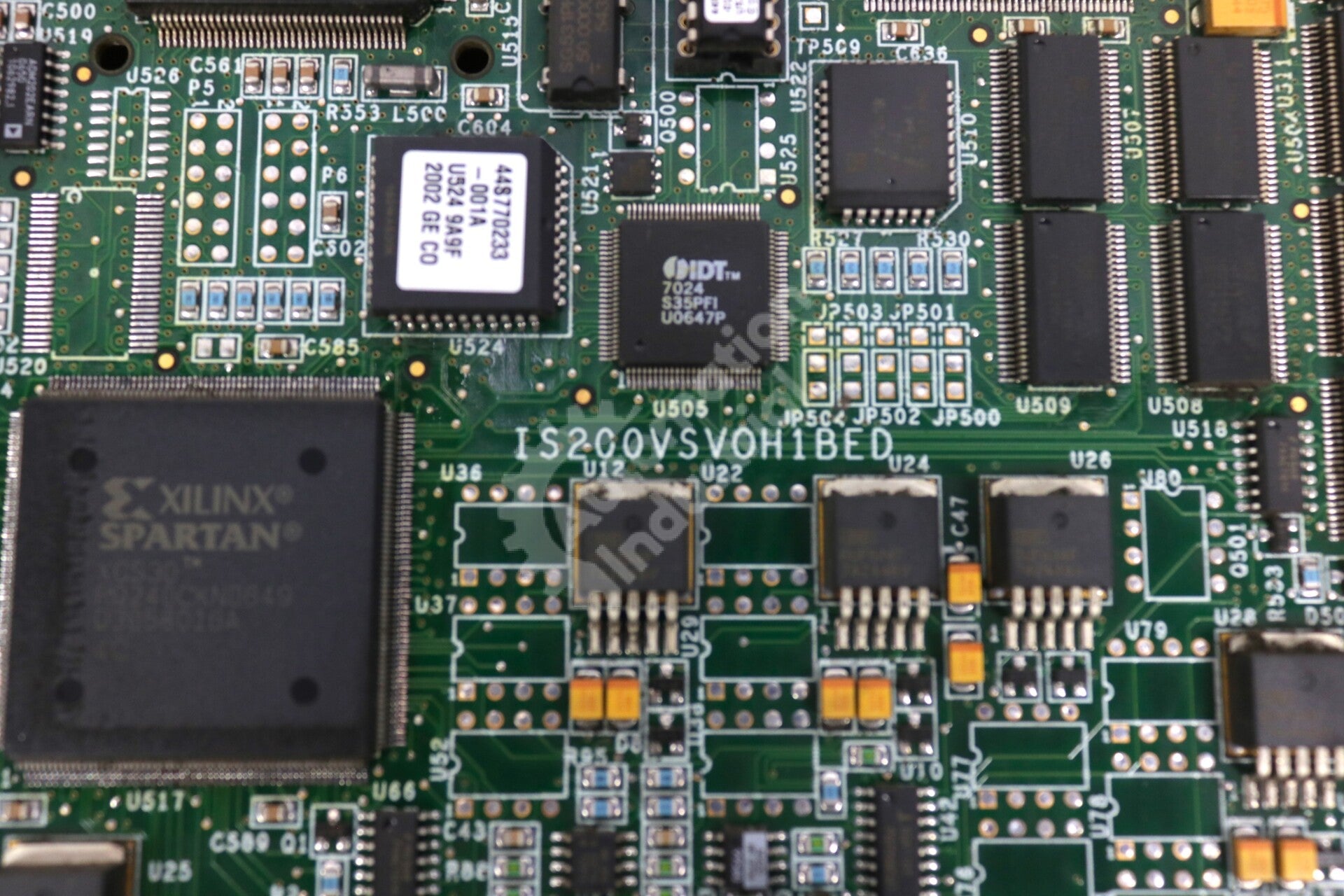
Why This Is Labeled an "Analog I/O Board" Rather Than Just an Input Card
IS200VAICH1B shows up under a few different names across the industry — VME Analog Input Card, Analog I/O Board, VAIC processor board — because it handles both directions of analog signal: 20 inputs and 4 outputs on the same card, using an onboard analog multiplexer, A/D converter, and D/A converter. Two of the four output circuits are fixed at 4-20 mA; the other two can be configured for 4-20 mA or 0-200 mA. None of that traffic touches field wiring directly — it all passes through a companion TBAI (or DTAI) terminal board connected to the VAIC by cable.
How Power Reaches the Transducers in a TMR System
In a Triple Modular Redundant panel, the terminal board doesn't just fan input signals out to three VAICs in the R, S, and T racks — it also handles the 24 V DC loop power sent to field transducers from all three VME racks, diode-OR'd together on the terminal board so a single rack losing power doesn't drop transducer excitation. Each analog output current is likewise produced by all three VAICs and voted to the median value, with the actual output current measured through a series resistor and fed back to each card for verification. If your field transducers can also be independently powered, that's supported too — they don't have to run off the control system's 24 V DC bus.
Symptoms That Look Like a Bad VAIC (and Often Aren't)
-
Loss of transducer power on one channel: check the diode-OR circuit and 24 V DC supply at the terminal board before assuming the card's output stage has failed.
-
A single channel reading incorrectly on a TMR system: if the other two VAICs agree and only one channel on one card disagrees, look at that specific field wiring and transducer before swapping the card.
-
Fault immediately after a board swap: almost always a terminal-board generation mismatch (see below), not a defective replacement.
-
Erratic or noisy signal: check cable shield termination and separation from high-current wiring in the cabinet; VAIC's own noise suppression and configurable low-pass filtering can only do so much against poor field wiring practice.
Suicide Relays and Output Protection
Diagnostics on the output side continuously monitor D/A output values, actual output current, total current, suicide relay status, and the 20/200 mA scaling relays for reasonableness, and can flag a fault if something doesn't add up. A suicide relay disconnects an output if a fault can't be cleared by a command from the controller — so a "dead" output on a TMR system may be the protection scheme doing its job, not a hardware failure to repair.
What the H1B Suffix Tells You
IS200VAICH1B IS200VAICH1BED sits in the original VAIC generation (through H1C), which pairs with a TBAIH1B-or-earlier terminal board, or any DTAI revision, and supports up to 500 Ω of load on a 20 mA output over 1,000 ft of #18 wire. The newer H1D generation needs TBAIH1C or later, or STAI, and supports higher loop loads — don't mix the two families. The ED following H1B marks this unit's specific revision; match it to the label rather than assuming interchangeability across all H1B boards. See our part number decoder for the full breakdown.
Related Boards
TBAI/DTAI terminal boards and the VCMI communications card are the usual companions. Our Speedtronic turbine control boards collection covers the rest of a Mark VI panel.
What to Send With Your RFQ
- Full part number and suffix (IS200VAICH1BED)
- Simplex or TMR configuration
- Turbine model and site
- Urgency and quantity needed
Request a Quote
No checkout price is shown — send your requirement through Request a Quote and we'll reply within 24 hours with DDP pricing and lead time. Worldwide shipping, purchase orders accepted.
General Information about the Product |
Part Number |
IS200VAICH1B Mark VI IS200 |
Description |
IS200VAICH1B By General Electric IS200VAICH1BED Analog I/O Board Mark VI IS200 |
Condition |
used Cleaned and Tested. With 1 Year Warranty. |